Marcel Duchamp – Fountain (October 23, 1990)
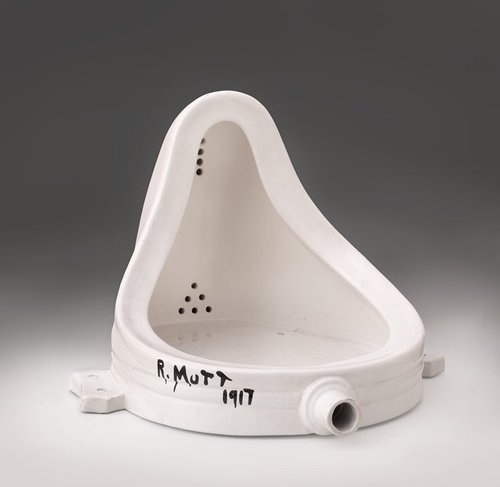
Musician, producer and artist Brian Eno successfully urinated on a replica of Marcel Duchamp's Fountain while it was on display at MoMA, New York, on October 23, 1990.
[No during/after image available. The image above is from the MoMA's website, though there is no way of telling if this particular piece was the piss recipient in question.]
[No during/after image available. The image above is from the MoMA's website, though there is no way of telling if this particular piece was the piss recipient in question.]
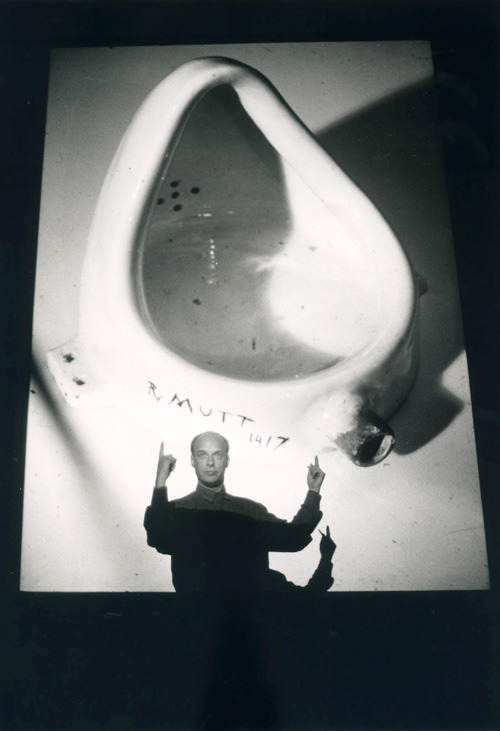
Eno lecturing at MoMA the night of the intervention.
The attempt was notable in that it was the first defacement of Fountain in a gallery setting, the first in a series of Fountain urinations, and because Eno managed to circumvent the piece's display case using an elaborate apparatus he described in his book A Year With Swollen Appendices:
Although most sources place Eno's intervention at some time in 1995, Paul Ingram in 3:AM Magazine demonstrates that the "High and Low: Modern Art and Popular Culture" exhibition in which Fountain was included ran at MoMA from October 7, 1990 to January 15, 1991; he also notes that the intervention was used as the basis for a lecture given by Eno at the gallery the same evening, yielding a precise date. (Further, the interview below in which he discusses the intervention was filmed in 1993, which rules out 1995 definitively.)
Eno described his motivation in an interview with designer Ron Arad for French television:
He was also quoted as saying:
The work was presumably unperturbed by the piss.
Eno interviewed by Ron Arad for Encounter, ARTE France, 1993.
The relevant section is 17:11–20:57.
pissing in duchamp's fountain, Paul Ingram, 3:AM Magazine, June 23, 2014.
Art attacks, Mark Blacklock, The Telegraph, June 26, 2003. The author, his tongue in cheek, "blames" Eno for inspiring the current climate of art interventionism.
An Overview of the Seventeen Known Versions of Fountain, Cabinet, Issue 27, Fall 2007. Useful. [archive]
In his book Error, Misuse, Failure: Object Lessons from the English Renaissance (U. of Minnesota Press, 2003), Associate Professor of English Julian Yates cites the incident as a miniature encapsulation of one chapter's premise that "it is possible to read a culture's history through its plumbing".
Toronto-based artist Dave Dyment's article A Short History of Piss In Art mentions the incident only fleetingly, but is excellent for a comprehensive background to the piss/art nexus.
Odd books website Biblioddity once had a review of A Year With Swollen Appendices which also had a longer excerpt of Eno's telling of the event.
Grayson Perry mentions the incident in his book Playing to the Gallery: Helping contemporary art in its struggle to be understood (Penguin UK, 2014), quipping that it reminds him of the part of the famous Bill Hicks "marketing and advertising" routine that no-one ever quotes, the part where the marketing and advertising guys express enthusiasm about "the anti-marketing market", "the righteous indignation dollar"; but seems to offer no further comment beyond this, at least in the available excerpt. Like everyone else, he also gets the date wrong.
Nerve Net/The Shutov Assembly/Neroli/The Drop (reissues) (review), Nick Hutchings, The Quietus, December 16, 2014. Brief discussion of the above. [archive]
Museum of Defaced Art 2025–
I've always wanted to urinate on that piece of art, to leave my small mark on art history. I thought this might be my last chance — for each time it was shown it was more heavily defended. At MoMA it was being shown behind glass, in a large display case. There was, however, a narrow slit between the two front sheets of glass. It was about three-sixteenths of an inch wide.
I went to the plumber's on the corner and obtained a couple of feet of clear plastic tubing of that thickness, along with a similar length of galvanized wire. Back in my hotel room, I inserted the wire down the tubing to stiffen it. Then I urinated into the sink and, using the tube as a pipette, managed to fill it with urine. I then inserted the whole apparatus down my trouser-leg and returned to the museum, keeping my thumb over the top end so as to ensure that the urine stayed in the tube.
At the museum, I positioned myself before the display case, concentrating intensely on its contents. There was a guard standing behind me and about 12 feet away. I opened my fly and slipped out the tube, feeding it carefully through the slot in the glass. It was a perfect fit, and slid in quite easily until its end was poised above the famous john. I released my thumb, and a small but distinct trickle of my urine splashed on to the work of art.
Although most sources place Eno's intervention at some time in 1995, Paul Ingram in 3:AM Magazine demonstrates that the "High and Low: Modern Art and Popular Culture" exhibition in which Fountain was included ran at MoMA from October 7, 1990 to January 15, 1991; he also notes that the intervention was used as the basis for a lecture given by Eno at the gallery the same evening, yielding a precise date. (Further, the interview below in which he discusses the intervention was filmed in 1993, which rules out 1995 definitively.)
Eno described his motivation in an interview with designer Ron Arad for French television:
There it was, sitting in the museum. I had seen it already at the Sao Paolo Biennale four years before. I'd seen it in London 12 years before that. And I thought, "How ridiculous, that this particular pisspot gets carried around the world at..." It costs about 30 or $40,000 to insure it every time it travels. I thought, "How absolutely stupid. The whole message of this work is, you can take any object and put it in a gallery. It doesn't have to be that one. That's losing the point completely."
And this seemed to me an example of the art world, once again, covering itself by drawing a fence around that thing, saying, "This isn't just any ordinary pisspot. This is the one, the special one, the one that is worth all this money."
So I thought, "Somebody should piss in that thing, to sort of bring it back to where it belonged." So I decided it had to be me. [YouTube]
He was also quoted as saying:
Since de-commodification was one of the buzz words of the day, I described my action as re-commode-ification. [Quietus]
The work was presumably unperturbed by the piss.
Further reading
Eno interviewed by Ron Arad for Encounter, ARTE France, 1993.
The relevant section is 17:11–20:57.
pissing in duchamp's fountain, Paul Ingram, 3:AM Magazine, June 23, 2014.
Art attacks, Mark Blacklock, The Telegraph, June 26, 2003. The author, his tongue in cheek, "blames" Eno for inspiring the current climate of art interventionism.
An Overview of the Seventeen Known Versions of Fountain, Cabinet, Issue 27, Fall 2007. Useful. [archive]
In his book Error, Misuse, Failure: Object Lessons from the English Renaissance (U. of Minnesota Press, 2003), Associate Professor of English Julian Yates cites the incident as a miniature encapsulation of one chapter's premise that "it is possible to read a culture's history through its plumbing".
Toronto-based artist Dave Dyment's article A Short History of Piss In Art mentions the incident only fleetingly, but is excellent for a comprehensive background to the piss/art nexus.
Odd books website Biblioddity once had a review of A Year With Swollen Appendices which also had a longer excerpt of Eno's telling of the event.
Grayson Perry mentions the incident in his book Playing to the Gallery: Helping contemporary art in its struggle to be understood (Penguin UK, 2014), quipping that it reminds him of the part of the famous Bill Hicks "marketing and advertising" routine that no-one ever quotes, the part where the marketing and advertising guys express enthusiasm about "the anti-marketing market", "the righteous indignation dollar"; but seems to offer no further comment beyond this, at least in the available excerpt. Like everyone else, he also gets the date wrong.
Nerve Net/The Shutov Assembly/Neroli/The Drop (reissues) (review), Nick Hutchings, The Quietus, December 16, 2014. Brief discussion of the above. [archive]